New Zealand astronomers and many others around the world were saddened to learn last Monday, 16 April 2007, of the death of Frank Bateson, for long New Zealand's most famous astronomer.
Dr Grant Christie of Auckland's Stardome Observatory, and RASNZ Vice President, has compiled the following tribute.
Frank Bateson organised variable star observing in New Zealand, providing leadership to the field in the Southern Hemisphere for 78 years. The son of Charles and Alice Bateson, he was educated at the Hurworth Preparatory School in Wanganui, NZ and at Scots College, Sydney, Australia.
He developed a keen interest in astronomy after reading "Great Astronomers" by R. S. Ball. He made his first observations of meteors in 1923 (Donovan Prize, 1923) and then variable stars in 1924 (Donovan Prize, 1924). He joined the BAA (NSW), was lent a small refractor and allowed to use the refractor at the Sydney Observatory.
Bateson left school and started working in 1925 in business administration and accountancy, a career that he followed for most of his working life. He returned to NZ in 1927 and founded the Variable Star Section (VSS) of the NZ Astronomical Society (later the Royal Astronomical Society of NZ). He served continuously as Director of the Section for the next 78 years.
In 1931 he married Doris McGoldrick and they had two daughters, June and Audrey. Throughout these years Bateson continued his observation of variable stars and worked tirelessly to expand the VSS with its network of observers. During the Depression, the Batesons moved first to Auckland and then in 1937 to a job in Whangarei which allowed plenty of time to devote to astronomy.
After the end of war in 1945, Bateson moved to the Cook Islands to manage a trading company. From the tropics he continued his own observations (now with an 8 inch refractor) while also directing the VSS.
Under his leadership, the number of active observers increased as did the number and types of variable stars covered, most notably the dwarf novae. He established close working links with professional astronomers and provided them with data obtained through the extensive network of observers. He developed methods that allowed the observational results to be rapidly communicated.
In the late 1950s he began promoting his vision of a professional observatory in New Zealand in collaboration with Frank B. Wood of the University of Pennsylvania. Bateson conducted an extensive site-testing survey and recommended the site at Mount John near Lake Tekapo. The Mount John Observatory was established with the University of Canterbury in 1965; Bateson served as Astronomer-in-Charge until his retirement in 1969.
From his home in Tauranga, NZ, with his wife Doris he established a private nonprofit company (Astronomical Research Ltd) to administer the network of variable star observers. Bateson's research in variable stars has achieved international recognition, particularly from the professional astronomers who made extensive use of the results he collated. Approximately one million observations have been recorded and these have been published in hundreds of publications. Over 1000 charts of southern variable stars have been published (most with Mati Morel). In addition, he has personally authored over 300 scientific papers.
Frank Bateson was elected as a Fellow of the Royal Astronomical Society of New Zealand (RASNZ) in 1963 and had been a member of the Society for over 80 years. He served on the Council for many years and was a past President (1966-67). He was also an Honorary Member of numerous astronomical societies both within New Zealand and around the world.
Over his long career, Bateson was honoured by many major prizes and awards. He was elected to full membership in the International Astronomical Union and served as the first NZ representative. He received the Jackson-Gwilt Medal and Prize of the Royal Astronomical Society in 1960 and an honorary doctorate from the University of Waikato in 1979. He was awarded the Order of the British Empire (OBE) in 1970 for services to astronomy and the Amateur Achievement Award of the Astronomical Society of the Pacific in 1980. The asteroid 2434 Bateson was named in his honour.
With justification, he has been widely recognised as the father of modern New Zealand astronomy. His autobiography "Paradise Beckons" was published privately in 1989.
Frank Bateson died peacefully in Tauranga on April 16, 2007 in the company of his family.
BATESON, Frank Maine born 31st Oct 1909 in Wellington, NZ. died 16th April 2007 in Tauranga, NZ.
The funeral will be on Monday April 23rd at 11.00am at: St George's Anglican Church, 1 Church St, Gate Pa, Tauranga.
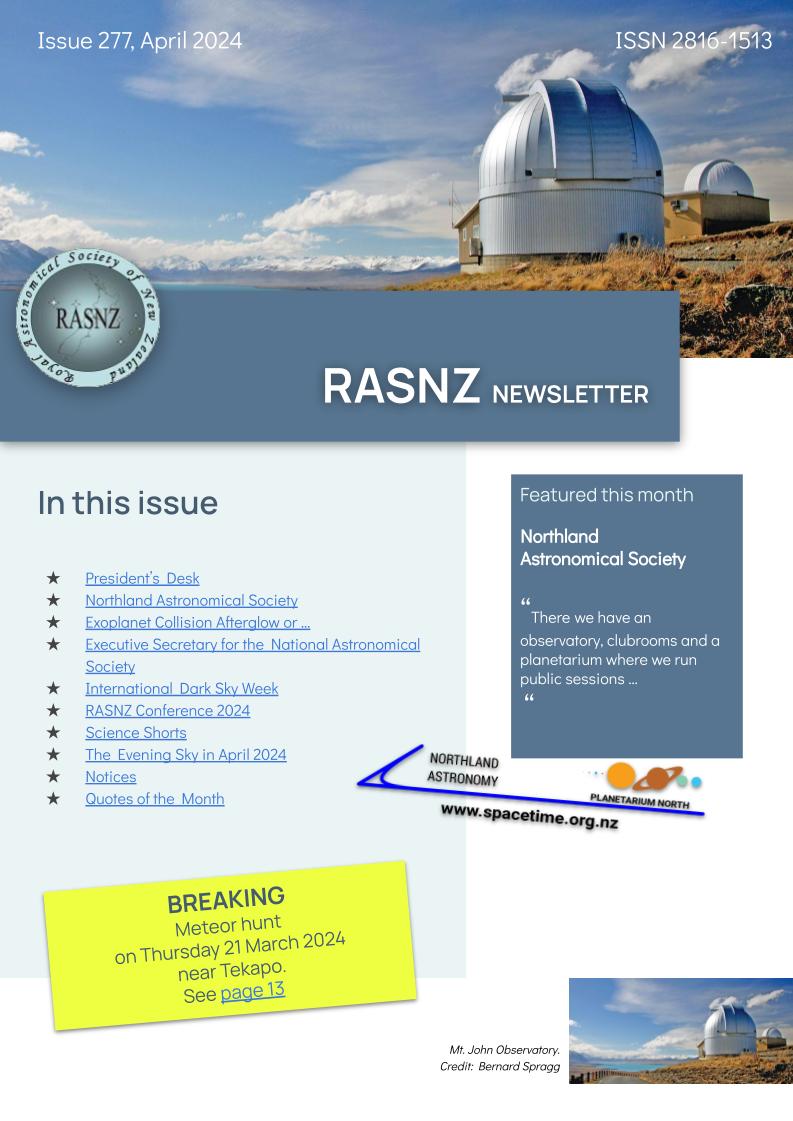
RASNZ front page.